
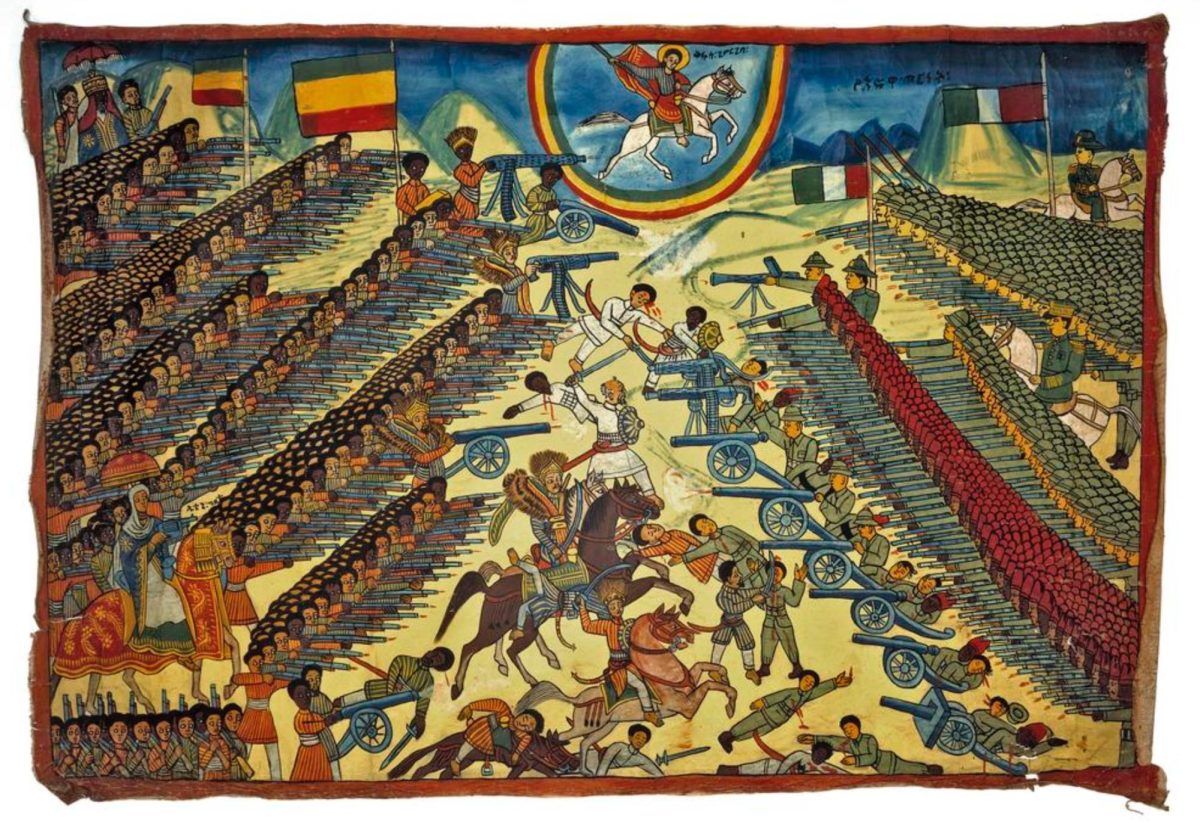
In March of 1896, challenging imperialistic ideologies, Ethiopia became the only African country to remain uncolonized, due to its victory against Italy at the Battle of Adwa. This was more than just pure luck—the victory of these ancient people is the very embodiment of one of the only examples of African sovereignty in the face of caucasian power. While African people take pride in this win, it is clear, even in modern-day, that the rest of the world ignores this triumph. An example of this global ignorance is the portrayal of the victorious Ethiopian leader, Emperor Menelik II. In the late 19th and early 20th centuries, Italian news articles depict the king as a white soldier and describe him as under Italian influence. This is rooted in two things: the pride that was crushed and the shame that rose in European hearts as a result of being defeated by people they had overlooked and outnumbered in battle. In that shame, a second notion arose: the Italians could not accept total defeat, so they felt entitled to steal the win. This deceit is beyond unintegratable, but it is just the beginning of the lies spread to save face.
Another instance is in the teaching of Western textbooks. Western textbooks teach that the Battle of Adwa was won at the cost of Emperor Menelik’s investments in advanced European weaponry. But why is it that my great-grandfather, an eyewitness to the war conditions in the country, claims the Ethiopians fought with nothing more than spears, swords, and the Orthodox covenant of Saint George? While Italian textbooks tell the victimized, out-gunned, and out-manned story, the unheard Ethiopian textbooks state that the war was likely to be in favor of the Italians. They had modernized weapons and armory as compared to the civilians, men, women, and children fighting for Ethiopia. In the few times that victory was admitted in Italian and even American textbooks, the win was attributed to the Emperor’s purchase of advanced Western weaponry, because giving credit to these historical people for their win based on anything else would throw off the reputation of the European empire, and may inspire similar ideas in other countries.
These are just a few examples of the East African triumph being ignored in global eyes, but it all goes to show that, oftentimes, powers not only silence minorities with defeat but also with the negligence seen applied to the matter. As ideal as it sounds, students deserve to hear the unbiased and factual truth behind each story. And they most definitely need to hear about revolutionary victories. Instead of teaching the information from the Italian and American sources, it is crucial that we add stories, accounts, and other relevant data from the Ethiopian experience of the war. No matter what we are taught in textbooks, it is always good to have individual opinions and explore the sides to choose. Ask questions, make inquiries when things sound unclear, because the story may not always be how it appears.