

“Show us what democracy looks like! This is what democracy looks like!” On February 4, 2026, over 700 Claremont High School (CHS) students walked out of their 5th and 6th-period classes to protest the overreach of the U.S. Immigration and Customs Enforcement (commonly referred to as ICE).
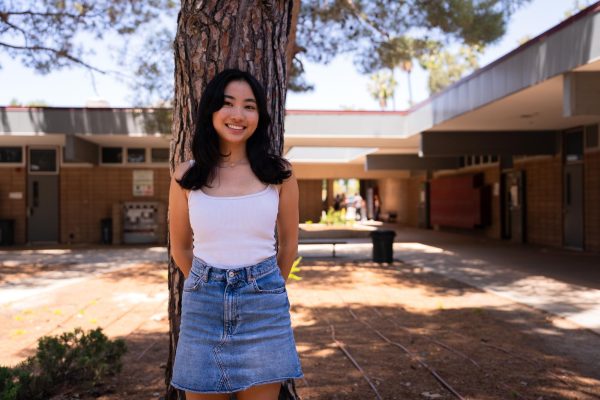
The walkout was largely organized by CHS juniors Zaira Amara and Cosette Fimbres. “ICE is literally in our communities,” Fimbres said. “Zaira and I are POC [people of color], and there’s a huge POC community on campus, so we thought it’d be a really good thing to use our voices and speak out.”
To prepare for the walkout, informational flyers circulated across social media. “I remember the day after [I started posting about preparation for the walkout], my friend was going through Instagram, and every single person was reposting [the flyer],” Amara said. “I originally didn’t think it would leave my circle.” As word spread, groups such as the Student Union and teachers such as English teacher David Chamberlain opened their classrooms for students to make protest signs. “I’m trying to walk a fine line myself and not necessarily promote [the walkout], but provide a space for people to engage and express their voices safely,” Chamberlain said.
Many students wanted to participate in the walkout, but were unclear about the repercussions. Claremont Unified School District (CUSD) clarified in an email on February 2, 2026, to families that under California’s Education Code 48205, parents of students in grades 7-12 can clear their student’s absence for political engagement once a year by contacting the attendance office. CUSD Superintendent Jim Elsasser emphasizes the district’s role in protecting student safety.
“The District does not plan to discipline students based on the walkout,” Elsasser said. “The District is not taking a position on the political message of the walkout. Supervising students during a walkout […] reflects our responsibility to care for students during the school day and to follow state law that protects students’ rights and privacy.”
Many teachers participated in the walkout despite CUSD’s neutral stance. Teachers have to act in accordance with the rules of the Claremont Faculty Association and the California Education Code section 44814, where they are entitled to a 30-minute duty-free lunch period, allowing them to participate in the protest without repercussions if they choose to. Within these limitations, many teachers still found ways to show their support. CHS physics teacher Mario Carrillo went to the walkout during his lunch period and returned to teach his 5th period. CHS Stage Technology teacher Cris Quick explained why she was at the walkout during lunch. “My job is to make the world a better place for you guys and to fight for you guys,” Quick said. CHS U.S. History teacher Molly Arboleda attended the walkout and expressed her great pride in the students. Similarly, CHS Math teacher Nathan Casas participated in the general strike, “ICE Out,” on January 30, 2026, by refraining from teaching mathematics to encourage open dialogue. “My role [as a teacher] is to make sure that students have a safe space to engage in conversations with each other,” Casas said. “We have a mini society in CHS, and what we do here, hopefully, is practice for when we are no longer in high school.”

Among CHS students, some were divided on the effectiveness of the walkout’s implementation. Senior Dylan Ortiz, the former president of the Young Republicans club, expressed his doubts about the merit of the walkout. “I cannot take any protest seriously that has to ask permission from the authority to do civil disobedience,” Ortiz said. Other students were indifferent to the walkout due to political disengagement. “I’m too tired for democracy,” an anonymous senior said.
Many students, though, were excited to be a part of the movement. After the bell for 4th period rang, students marched down Indian Hill Boulevard and lined the intersection, posters in hand. Senior Elijah Balcazar shared the message behind his poster.
“My poster says ‘This is America,’” Balcazar said. “I put four pictures of people who were killed by ICE. America is about freedom and liberty. It’s about opportunity. And out of these five people, four of them died just trying to find that liberty and opportunity here in America. Coming from a Latin household, it upsets me a lot because this is my race, this is my culture, and this is America, and we’re all looking for freedom.”
For over two hours, students marched, climbed street lights and the U.S. Bank sign, reciting phrases like “F— ICE” and “Hey, hey, ho, ho—Donald Trump has got to go.” Egan Little, a CHS junior, led chants with his megaphone, with his favorite being “Who do we hate? ICE! When do we want them gone? Now!”
As students continued shouting along Indian Hill Boulevard, many described the walkout not just as a protest, but as a moment of collective voice. “I’m here to support the people that don’t have a voice and speak out about this,” an anonymous CHS student said.
Students across all four grades described the moment as “powerful,” “moving,” and “freakin’ empowering.” Despite diverse political views on campus, the walkout taught students the value of speaking out. “Keep talking about it, keep the word alive, and keep the movement alive,” Amara said.
As students lined the intersection, chanting and holding signs, they were not just protesting, but gaining firsthand experience in civic engagement.
“We’re the future,” Fimbres said. “We’re future voters, future politicians, future workers. So our voices matter—a whole lot.