

The Claremont Unified School District (CUSD) has outlined explicit priorities for the International Baccaleaurate Middle Years Programme (MYP): a scaffolded curriculum designed for seamless progression, uniform grading standards for equity, external moderation for Personal Projects (passion projects 10th grade students opt in to do to earn the MYP certificate), and formalized systems for student feedback. The 2025-2026 academic year marks the first full rollout of MYP at Claremont High School (CHS) and El Roble Intermediate School, following official authorization by the International Baccalaureate (IB) in May 2025. While the new priorities are a step in the right direction towards MYP’s promised holisticity, students still report significant inconsistencies in their experiences with the curriculum, grading, and student feedback systems. CUSD’s MYP implementation is evaluated by IB moderators once every five years; the plan is for MYP to be fully implemented for evaluation by the 2029-2030 academic year. That said, internal mechanisms for measuring progress are still very limited.
There are two main changes surrounding curriculum: vertical articulation (curriculum designed so each year builds directly on prior learning) and scaffolding (multi-tiered assignments that cater to students at different readiness levels, designed as a replacement for Honors courses). Meanwhile, grading changes are limited by CUSD’s budget realities: teachers only meet in one to three all-day pullouts per year and bi-monthly department meetings to align their grading by comparing scores on shared assignments and discussing assignments they found effective. Andrea Gosnell, coordinator of CUSD’s MYP program, highlights the benefits of the MYP system. “Every teacher teaches differently, but we all have different strengths within our teaching styles, and when teachers come collaboratively together, they build on the strengths of one another,” Gosnell said.
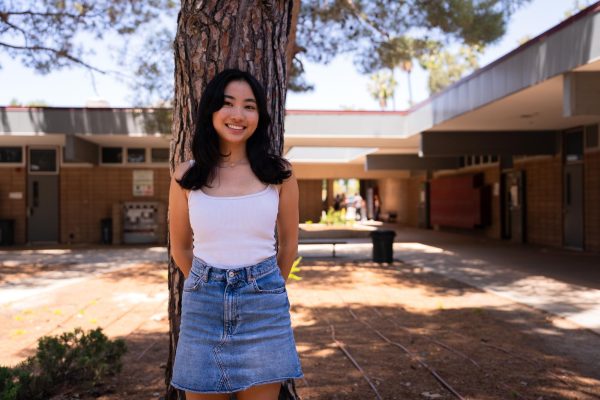
Despite these changes, promised uniformity unravels once in a real-life class setting. Teachers continually interpret the 8-point rubric at different levels of stringency, leading to what students believe is “splitting hairs” between a 7–8 (equivalent to an “A”) and a 5–6 (equivalent to a “B”). Scaffolding varies dramatically from teacher to teacher, and grading practices show similar inconsistencies. Margot Park, a CHS sophomore who is in her fourth year of MYP, had not heard of the term “scaffolding” or seen it implemented in her classes. “I feel like teachers provide everyone with the same amount of support […] it is like traditional school where you just do your work, and then it gets graded,” Park said. CHS sophomore Pearl Haney, who led an MYP protest movement in the 2024-2025 school year, echoed the same sentiment. “I had friends ask for harder work because they found MYP curriculum too easy, and [teachers] are like, ‘I am sorry, this is what you get,’” Haney said.
These inconsistencies raise a larger question: how will the district measure whether any of these changes are working? For Personal Projects, IB moderation ensures district grades align with IB evaluators’ scores. However, an interview with Gosnell revealed few concrete metrics for curriculum and grading, and the goals provided remain general rather than actionable. Through email correspondence, when asked, “How is success measured?” Gosnell provided the district’s five-year grading vision: “Increasing grading consistency across courses; Improving alignment to standards; Ensuring grades reflect student learning, not behavior; Supporting schools in using clear rubrics, common assessments, and shared expectations.” Given the subjective nature of MYP grading, establishing concrete evaluation methods will be important in determining whether these priorities are being met.
Beyond measurable outcomes, another critical question emerges: how are students’ voices incorporated into the process? Kathryn Dunn, President of the CUSD Board of Trustees, provides input on the status quo of student feedback through an email correspondence.
“Student feedback is already gathered through several existing processes, such as the district’s annual LCAP [Local Control Accountability Plan] survey, CHS and SAHS [San Antonio High School] student board members, and the Superintendent’s High School Advisory Council (SHAC), which provides direct student input on programs and priorities,” Dunn said. “If the Board were to consider additional policies specific to MYP in the future, it would likely build on these existing feedback structures and further formalize how student perspectives are collected, reported, and used in decision-making. The board greatly values student feedback, as it helps them better define goals and priorities.”
Despite current efforts, student input still appears to remain absent and fail to be implemented in course planning. Limited transparency on how student input influences instruction and a lack of well-advertised, frequent student-feedback systems create a discrepancy between what students experience and what the district promises. “I do not think I have any memory of giving feedback to anyone,” Park said. Park’s experiences reflect a broader gap in student feedback. In an interview, Gosnell noted student feedback will be taken after every unit. In other words, the district currently relies on informal recognition of the need for feedback, but without formalized in-classroom systems, there is little accountability to ensure that student input is consistently collected and used. Park had some suggestions on how student feedback could be taken.
“[Mrs. Gosnell] could ask us during [Personal Project workshop meetings], ‘How can we help you more?’ […] or we can talk with our homeroom teachers if we do not want to give the feedback directly to Mrs. Gosnell,” Park said. “It is not a perfect program. There are always changes that can be made.”
The recent authorization in May 2025 is merely a starting line. While the system should now be fully in effect, many structures still feel new. Implementation varies by department and teacher, and students express confusion about what exactly MYP means in practice. Going forward, CUSD will need clear, actionable benchmarks to measure progress as the program moves from aspiration to reality.